
Empowering Language Teachers through Research Literacy (Larissa, 6 Dec 2025)

ReaLiTea is now approaching its third year, and with that comes a gradual shift from drafting our research-literacy resources to piloting and disseminating them. It was in this spirit that the University of Thessaly ReaLiTea team travelled to Larissa, Greece, to run a professional development workshop for teachers of second, additional and foreign languages on 6 December 2025.
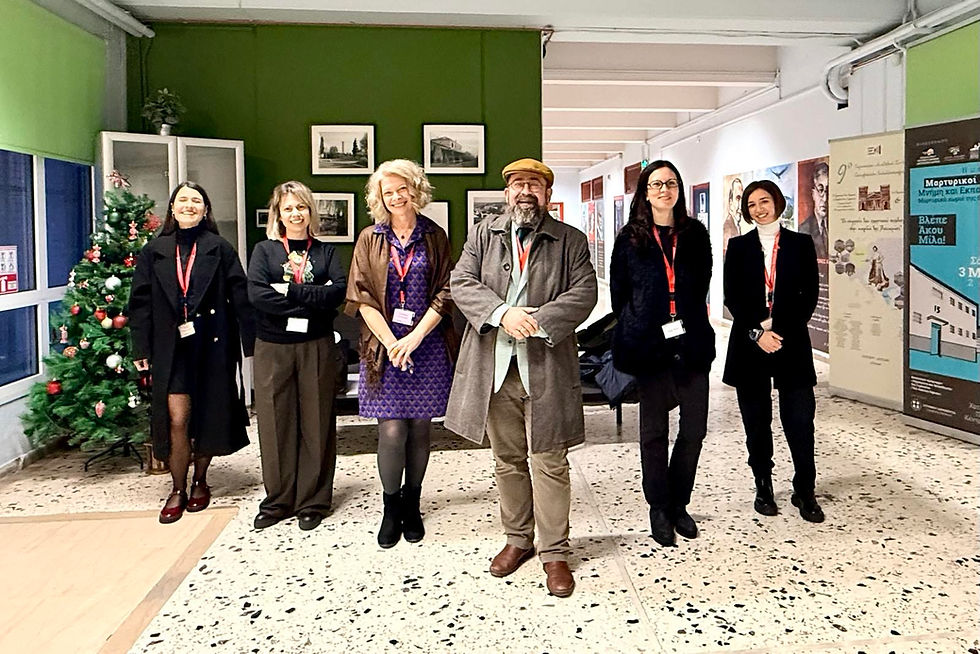
In true ReaLiTea fashion, the workshop unfolded under less-than-ideal conditions: roadblocks by protesting farmers and a storm-related travel advisory made getting to Larissa a small achievement in itself. And yet, despite such challenges, the event —enthusiastically supported by the Regional Directorate of Education in Thessaly and generously hosted at the 5th High School of Larissa, and brilliantly managed by Eleni Motsiou and our incredible administrative assistants, Evangelia Theodoropoulou and Dimitra Giannouka— brought together 42 teachers of English, French and German. Most were public-school teachers and many were pre-service teachers working towards their teaching qualifications; this mix of more seasoned teachers and participants whose role involved more active research engagement set the tone for a day of thoughtful enagement, collaboration and reflection —exactly the kind of environment in which ReaLiTea continues to grow.
Overview of the workshop
The day began with an overview of research literacy and the way it supports engagement with (and in) research, led by me (Achilleas Kostoulas). In this session, the participants and I walked through the ideas behind the ReaLiTea framework, not as abstract principles, but as practical tools for thinking about questions that matter in everyday teaching. This generated some thought-provoking discussions about the disconnect between theory and practice (a topic frequenly discussed in this blog) and the niche that this creates for knowledge-building from language teachers for language teaching.
In-service and pre-service teachers working together Sofia Tsioli discussing the concept of Justice in research outputs for language education Achilleas Kostoulas presenting copies of Doctoral Study and Getting Published (courtesy of Emerald) Evgenia Tassou working with language teachers on research literacy Achilleas Kostoulas and Dimitra Giannouka working with teachers Evgenia Tassou working with teachers Achilleas Kostoulas waiting for participants
Following that, the participants were divided into groups, each working with different sets of materials for supporting autonomous research engagement. Although these resources were technically desinged for self-study, Jenny Tassou and Sofia Tsioli brought them to life in a way that made the tasks feel collaborative rather than solitary. They guided the groups gently, offering just enough structure to keep everyone moving while leaving plenty of space for teachers to make their own connections and discoveries. What emerged was a surprisingly lively conversation in each corner of the room. Some groups gravitated towards refining research questions; others explored how knowledge can be accessed and what alternatives exist to paywalled articles; and a few found themselves debating what “evidence” actually looks like in a busy language classroom.
Building communities
I have commented elsewhere that such projects often have a 'hidden deliverable', in addition to the ones stated in the funding proposals and project documentation. This is the community of people that comes together and is built around such events. Mingling with the participants during the coffee and lunch break left me with a clear sense that such community was already emerging: teachers sharing experiences and talking about their frustrations and small victories, offering practical advice to one another both about teaching and about research engagement, making plans to stay in touch, and (perhaps most importantly) realising that they are not alone in wanting to approach their work in a thoughtful, evidence informed way.

At the end of the day, I was left with a feeling of satisfaction and pride about making such conversations possible - the kinds of conversations that no formal activity can manufacture. It reminded me that, beyond frameworks, resources and workshops, ReaLiTea is ultimately about helping teachers find allies, confidence and a shared professional language.


Comments